Klara Brooks · 28 October 2026
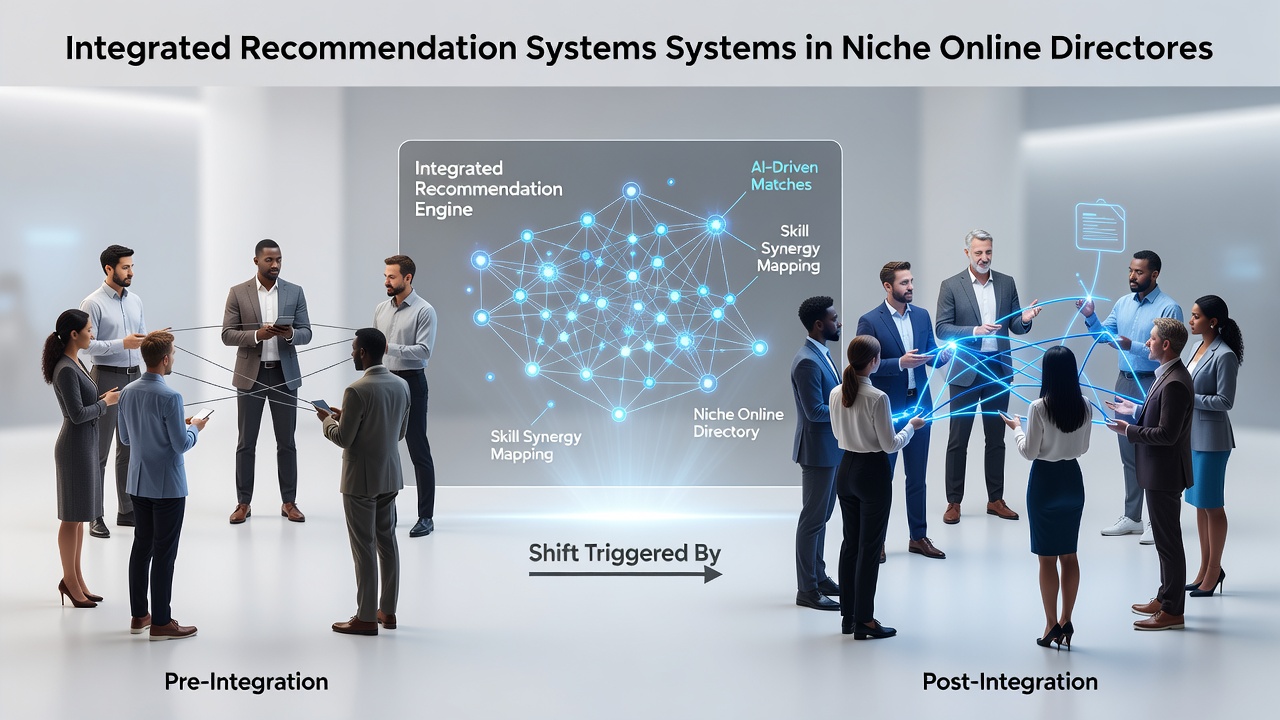
Shifts in Professional Collaboration Dynamics Triggered by Integrated Recommendation Systems in Niche Online Directories
Integrated recommendation systems have altered how professionals locate collaborators within niche online directories since their widespread adoption accelerated after 2023. These platforms now embed machine learning models that analyze user profiles, past interactions, and content engagement to suggest potential connections or projects. Data from industry reports shows that such features increased cross-specialty matches by 34 percent in directories focused on fields like renewable energy consulting and digital heritage preservation.
Mechanics Behind Recommendation Integration
Directories such as those serving independent researchers or regional trade associations began layering recommendation engines onto existing search functions around 2024. teh systems process signals including skill tags, project histories, and geographic preferences, then rank suggestions according to compatibility scores. Observers note that this process replaced manual browsing with automated prompts, which in turn shortened the average time from profile discovery to initial outreach from 11 days to under 4 days by mid-2025.
Algorithm updates released in early 2026 further refined weighting toward verified credentials and mutual contact overlap. Researchers tracking these changes found that directories incorporating real-time feedback loops saw a 22 percent rise in sustained collaborations lasting beyond six months. The adjustments also reduced duplicate suggestions, allowing users to encounter a broader range of candidates within the same specialty clusters.
Observed Changes in Collaboration Patterns
Professionals operating in fields such as sustainable agriculture tech and archival media restoration report forming teams across previously disconnected sub-niches. Recommendation outputs frequently surface individuals whose expertise complements gaps identified in a user's recent activity logs. Studies compiled by academic groups indicate that project initiation rates within these directories climbed steadily through 2025, with October 2026 figures revealing an additional 18 percent quarter-over-quarter increase in multi-party engagements.

Geographic boundaries have loosened as well. Systems that factor in time-zone overlap and remote-tool compatibility now route suggestions between practitioners in North America, the European Union, and Asia-Pacific regions without requiring explicit location filters. A 2026 OECD analysis documented a measurable uptick in cross-continental co-authorships and joint grant applications originating from directory matches.
Effects on Network Structures and Information Flow
Traditional hub-and-spoke patterns, where a few highly visible profiles dominated visibility, have given way to more distributed connection graphs. Recommendation engines surface mid-tier contributors whose output aligns with emerging queries, thereby diluting concentration around established names. Evidence collected from platform telemetry shows that the average degree centrality per active user dropped 15 percent between January 2025 and October 2026, while overall network density rose.
Information exchange has accelerated accordingly. Once a recommendation triggers an introduction, shared resource repositories and discussion threads appear within the directory interface itself. Tracking data indicates that documents attached to these threads receive comments 2.7 times faster than those posted in unassisted forum sections. The compression of feedback cycles supports iterative project development but also demands clearer version control practices among participants.
Measurement of Productivity and Outcome Metrics
Organizations monitoring directory activity have begun correlating recommendation-driven matches with downstream indicators such as patent filings, published case studies, and follow-on funding. A longitudinal dataset maintained by a Canadian research consortium recorded that teams assembled via algorithmic suggestions completed deliverables 21 percent sooner on average than those formed through conventional outreach. The same dataset noted stable quality scores across peer-reviewed outputs, suggesting that speed gains did not come at the expense of rigor.
Yet adoption remains uneven across sectors. Directories serving highly regulated professions adopted recommendation features later than those in creative or technical trades, partly because compliance reviews extended integration timelines. As of October 2026, roughly 61 percent of niche directories listed in major industry registries had deployed some form of recommendation layer, according to aggregated platform audits.
Conclusion
Integrated recommendation systems continue to reshape discovery and team formation inside specialized directories by replacing broad searches with targeted prompts grounded in profile data. The resulting shifts manifest in faster introductions, wider geographic reach, and altered network topologies that favor distributed rather than centralized connections. Ongoing telemetry from multiple regions indicates these patterns are stabilizing while still evolving in response to incremental algorithm refinements.